



AI-first startups are everywhere. But moats? Rare. In a world where every feature is now “AI-powered,” how do you stand out?
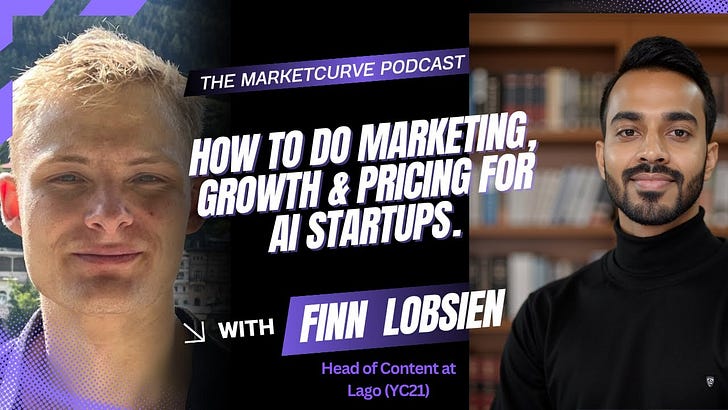
I recently sat down with Finn—Head of Content at Lago (YC21), Hacker News whisperer, and Reddit viral wizard—to break down exactly what separates AI startups that break out from the pack... and those that fade into the slop.
Let’s dive in.
Brought to you by:

Market Curve is a premium tech storytelling studio run by me Shounak that turns tech companies into media companies. I’ve had the fortune of working with some of the top tech companies backed by some of the top investors like YCombinator, 20VC who have gone on to be acquired by companies like Roblox & Amplitude.
Here are a few things I can help you with —
Design a custom content system with AI agents + humans that helps your brand show up on LLMs.
Optimize your entire buyer journey across your landing page, pricing page and onboarding flow so you can get more customers without spending more on customer acquisition costs.
Build custom AI agents for your marketing/GTM/content teams that are embedded deep into your tech stack and can function autonomously.
Hire Rita AI - A Slack AI Agent that turns your voice notes or text messages into viral LinkedIn posts.
Interested?
See the full episode on YouTube:
AI Lowers the Effort for “Okay” Results
Finn kicked things off with this gem:
“AI compresses the time and effort needed to create a mediocre result. Not bad. Not great. Just... okay.”
That’s important. Because if everyone can now produce “okay” in seconds, the bar for standing out has actually gone up. The result? Most of the web becomes what Finn calls AI slop.
So if you’re an AI founder, your job is not to be okay. It’s to build something undeniably great.
Three Moats for AI Startups
Here are three real moats Finn believes will separate winners from the rest:
1. Distribution Moat (a.k.a. The Incumbent Advantage)
Big companies win because they have reach.
“AI is one of those revolutions that benefits incumbents. They already own distribution. They can bolt on AI and go 10x faster than you.”
If you’re just starting out and don’t have distribution, you need to earn it—fast. And that brings us to...
2. Brand Moat (Packaging > Product)
Your branding matters. In fact, it might be your best shot.
“We’re in a world where the packaging is more important than the product. If your site or video looks AI-generated and generic, no one clicks.”
The best brands today don’t look like they were whipped up by GPT-4. They look like someone cared.
Tactical takeaway: Use high-effort visuals, bold design, and clear opinions. Stand for something. That’s how people remember you.
3. Data Moat (The Hardest to Copy)
Proprietary data is one of the few remaining durable moats.
Take Cursor, a dev tool that captures what users try to build—and where they get stuck. That usage data can’t be faked, copied, or scraped.
“Cursor knows exactly what devs are building and where they need help. That’s gold.”
Not every startup starts with a moat. So how do you earn one?
Finn points to Cluely—a startup that went viral by leaning into controversy (“Cheat on anything with our product”) and combining that with slick video game-style UX.
They said the thing no one else would say.
If you want to stand out in an AI-generated world, you need to show effort.
“A super polished landing page or cinematic video signals humans made this. Not a 5-second GPT copy-paste.”
This is called costly signaling: You signal quality through the effort you visibly put in. Think of it like a luxury handbag. It’s tiny, overpriced—and that’s the point.
Let’s say you went viral. Now what? Here’s Finn’s framework:
Don’t treat virality as a fluke. Plan for it.
For every piece of content, ask: Why should this go viral?
Accept the 20% success rate. Play the volume game.
Capture emails. Build distribution. Turn one-off wins into compounding traffic.
“If 10,000 people see your content but you capture nothing, you’re starting from scratch each time.”
SEO is Changing. A Lot.
AI Search (AEO, GEO, LLMs) is not like Google Search.
“With LLMs, you don’t write to drive traffic. You write to be referenced in the answer.”
That means:
Write structured, query-focused content.
Answer the question directly.
Forget fluff. LLMs won’t use it.
Also, not every post needs to go viral. One Reddit post with two upvotes got referenced by ChatGPT just because it was specific and well-written.
Bottom line: Write to be cited, not clicked.
Finn’s Content Workflow (Steal This)
Finn is building AI agents to auto-generate blog posts using:
GPT (with custom system prompts)
N8n to automate content into CMS
Manual editing for quality
Banner generation
Publish
Right now it’s semi-automated. Soon, it’ll be end-to-end.
AI Tools in Finn’s Stack
Here's what Finn uses daily:
ChatGPT (with customized system prompts)
Perplexity (Google replacement)
N8n (automation)
Ahrefs for AI content
Rosebud (AI-powered journaling)
Key tip: Write better system prompts. Don’t use ChatGPT like a toy. Use it like an intern—with training.
Final Advice: From Finn to Himself
To 20-year-old Finn:
“Stop filling emotional holes with work. Figure out your personal stuff. Take your injuries seriously. Value relationships.”
To 40-year-old Finn:
“Don’t stop writing. Don’t stop reading. Don’t stop cooking. Keep a creative outlet alive.”
How to Stand Out as an AI Startup
Mediocrity is free. Quality is rare.
Own your brand. Make it bold, weird, human.
Build proprietary data. That’s your moat.
Say what others won’t. Controversy wins.
Use costly signaling. Show your effort.
Turn virality into a system, not a one-hit wonder.
Write for LLMs, not Google. Think citations, not clicks.
Choose a pricing model that reflects real value—and cost.
If you found this valuable, share it with a founder who’s building in AI. Or better, go make something so human, no AI could fake it.


